Hard and Soft Edges: Controlling the Eye
Hard and soft edges are the two ends of a transition between shapes. A hard edge is a crisp boundary and pulls the eye; a soft edge is a gradual blend and reads as a turning form or a soft material; a lost edge vanishes into a neighbour of the same value. Put the hardest edges at the focal point.
Two paintings can have identical shapes and values and read completely differently on their edges alone. Edge control is one of the quietest tools in painting and almost invisible until you learn to see it, which is why so many pieces with sound values in painting still look stiff. This tutorial covers hard and soft edges as a working system: the four edge types, how they direct attention, how they describe material and form, and a ten minute sphere exercise. It sits in the digital painting fundamentals pillar between values and layer modes.
The edge vocabulary: hard, firm, soft and lost
Painters name four edges rather than two, because the middle of the range does most of the work. Think of them as a dial from crisp to gone, and set it for every boundary in the picture.
| Edge | Transition width | Reads as | Brush to make it |
|---|---|---|---|
| Hard | 0 to 2 px | A sharp corner, a cast shadow, a point of focus, a hard material | Hard round, 100 percent opacity and flow |
| Firm | 3 to 10 px | A form turning quickly, a fold, a nearby object in focus | Hard round with a soft brush pulled once along the line |
| Soft | 10 to 40 px | A round form turning slowly, skin, cloth, cloud, anything out of focus | Soft airbrush at 20 to 30 percent, or a blender brush |
| Lost | No boundary | Two shapes of the same value merging; atmosphere, mystery, rest for the eye | Match values, then blend the join away entirely |
The National Gallery's entry on sfumato describes the soft and lost end of this dial as it was used in Renaissance painting: transitions blended so gradually that no line can be found. Tate's note on painterly work covers the opposite instinct, where visible strokes and broken edges are left on purpose. Both are edge decisions.
Edges and the focal point
The eye is drawn to the hardest edge and the highest value contrast, and it goes there first. Put your crispest edges at the focal point and soften everything as it moves away, and you control exactly where the viewer looks and in what order. A portrait with hard edges on the near eye and soft, lost edges in the hair and shoulders feels alive; the same portrait with uniform edges everywhere feels flat and tiring.
A practical budget: hard edges on no more than about 10 percent of the boundaries in a finished painting, firm edges on another 20 to 30, the rest soft or lost. If you cannot say where the hardest edge is, the picture has no focal point yet. The hardest edge and the strongest value contrast should land in the same place.
One hard edge per focal point, and every other boundary at least one step softer than it. When two areas compete, soften the one you want read second.
A second point of interest gets firm edges, never hard, so it reads after the main one. Lead the eye between the two with a chain of soft edges along a form or a fold, and let lost edges act as the exit. This is edge control painting in its plainest form: hard says stop, soft says move, lost says rest.
Edges describe material
A soft edge reads as skin, cloth or cloud. A hard edge reads as metal, glass or plastic. You can change what a surface appears to be made of without changing its color at all, by tightening or softening the edges of its highlights and shadows. Chrome is chrome because its edges are brutally hard; a wool sweater is wool because nothing on it has a hard edge, including the highlight.
| Material | Highlight edge | Core shadow edge | Form turn | Note |
|---|---|---|---|---|
| Cloth (matte) | Soft, barely present | Soft | Soft, firm only at creases | Folds get a firm edge on the lit side and soft on the shadow side |
| Metal (polished) | Hard, small, mirror-like | Hard | Hard, with stepped reflections | Reflections of the surroundings replace a smooth gradient |
| Skin | Soft to firm | Soft | Soft, firm at bone (nose bridge, cheekbone, knuckles) | Subsurface warmth softens the terminator further |
| Hair | Firm along the shine band | Soft into the mass | Soft, lost at the outer silhouette | Hard edges only on a few stray strands at the focal point |
| Glass | Hard, thin, doubled | Hard rim, transparent middle | Hard at the silhouette, lost inside | Highlights run along the contour, not across the form |
Hair is the case artists get wrong most, because they harden every strand. Paint the mass soft with a single firm shine band, then add three to five hard strands near the focal point; drawing hair as blocks builds those masses.
Edges describe the speed of the turn
On a round form the edge of the shadow, the terminator, is soft where the form turns gently and firm where it turns sharply. A sphere has a soft terminator all the way round; a cube has a hard one on every corner; a cylinder is soft along its length and hard at the end caps. Cast shadows behave the opposite way: hard at the point of contact and softer as the shadow travels away from the object that casts it.
| Form | Terminator edge | Cast shadow edge |
|---|---|---|
| Sphere or cheek | Soft, 20 to 40 px | Hard at contact, softening with distance |
| Cylinder or arm | Soft along the length, firm at the ends | Firm near the form, soft at the far end |
| Cube or box | Hard at each corner | Hard, sharpest on the near side |
| Fold in cloth | Firm on the lit side, soft on the shadow side | Soft, often lost into the next fold |
Blur only the terminator, never the whole shadow shape. A soft terminator with a hard cast shadow is what makes a form sit on a surface instead of floating.
A ten minute sphere exercise, timed
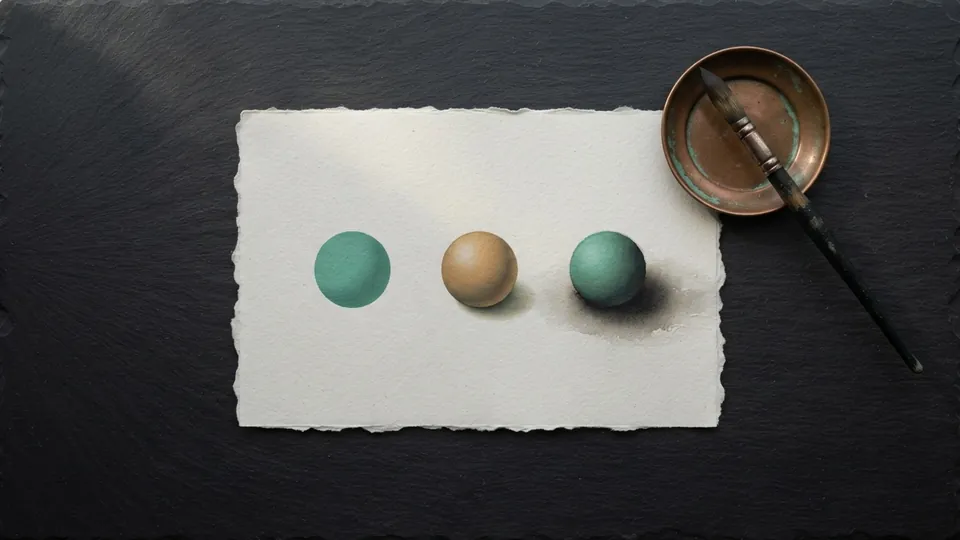
Three spheres, one light from the upper left, a 2000 px canvas, a hard round and a soft airbrush. Set a timer and keep to it; the time limits stop you from rendering and force edge decisions. The Krita Manual's Color Smudge engine page explains the smudge and dulling settings behind blender brushes if you prefer one to the airbrush for the soft passes.
Minutes 0 to 3: one sphere with only hard edges
Hard round at 40 px, 100 percent opacity. Block a light side, a shadow side and a cast shadow, each with a crisp boundary. It will read as a cut paper shape rather than a ball, which is the point.
Minutes 3 to 6: repaint it and soften the terminator
Duplicate the sphere. With a soft airbrush at 60 px and 25 percent opacity, blur only the line where light turns into shadow, two or three passes. Leave the cast shadow hard at the contact point. The sphere becomes round, because a soft terminator tells the eye the surface curves away gradually.
Minutes 6 to 9: lose one edge on purpose
Duplicate again. Fill the background behind the shadow side with a value that matches the core shadow, then blend the join away with the airbrush at 80 px. The form still reads from the lit side alone, and the image gains atmosphere. That lost edge is what separates a painting from a diagram.
Minute 9 to 10: add the one hard accent
On the third sphere, put a single hard highlight with a 6 px hard round where the light hits most directly. Now the sphere has one hard edge, one soft turn and one lost side: the whole vocabulary on one object.
Keep the three spheres side by side as a personal reference. When a painting feels stiff, the fix is usually on that sheet: too many hard edges, a terminator that is too crisp, or no lost edges anywhere.
Edge mistakes and the fix for each
| Mistake | How it looks | Fix |
|---|---|---|
| Every edge hard | Cut-out, sticker, or vector look; tiring to view | Soften all terminators first, then everything more than a head-width from the focal point |
| Every edge soft | Blurry, out of focus, no focal point | Add one hard edge at the focal point and firm edges at contacts and corners |
| Blurring the whole shadow instead of the terminator | Shadow looks like fog; the form floats | Keep the cast shadow hard at contact; soften only the turn |
| No lost edges | Diagram feel; the subject looks pasted on the background | Match one shadow side to the background value and blend it away |
| Hardening every hair strand | Wig, wire, or straw | Paint the mass soft, one firm shine band, three to five hard strands |
| Hard edges on far objects | Background jumps forward; depth flattens | Soften edges with distance |
Hard and soft edges, in short
Decide every boundary on a dial from hard to lost. Spend hard edges at the focal point and on hard materials, soften every gentle form turn, and lose at least one edge into the background. Hard and soft edges are what make a painting with good values feel like it has air in it. The next layer of control is the light itself, covered in layer blend modes for shading.
Common questions
What are hard and soft edges in painting?
A hard edge is a crisp boundary between two shapes with almost no transition. A soft edge blends the two over a wider band so the change is gradual. Between them sits the firm edge, and beyond soft is the lost edge, where two shapes of the same value merge and the boundary disappears.
What is a lost edge?
A lost edge is a boundary you cannot find because the two shapes on either side share the same value, so the eye cannot separate them. Painters lose edges deliberately on the shadow side of a form or where a subject meets a dark background. It adds atmosphere and gives the eye a place to rest between hard focal edges.
How do I soften an edge in digital painting?
Use a soft airbrush at 20 to 30 percent opacity and pull along the boundary two or three times, or use a blender or smudge brush at low strength. Soften only the transition you mean to soften, such as the terminator, and leave the cast shadow hard at its contact point.
Where should the hardest edge in a painting be?
At the focal point, usually where the strongest value contrast also sits, such as the near eye in a portrait or the point where a hand touches an object. There should be one clearly hardest edge; every other boundary is at least a step softer, and edges get progressively softer the further they are from that spot.
Sources and further reading
Primary references for the facts and definitions in this piece, all from independent publishers:
- The National Gallery: Sfumato: soft, lost transitions between tones used to turn form.
- Tate: Painterly: visible, broken brushwork and edges as a deliberate quality.
- Krita Manual: Color Smudge brush engine: the smudge and dulling settings behind blender brushes used to soften edges.
This method is part of the digital painting fundamentals pillar. Pair it with Layer Blend Modes for Shading, Explained and Blend Modes Cheat Sheet for Digital Painting. Keep the printable blend mode reference open while you paint.