Anime Face Proportions: Head Construction From Any Angle
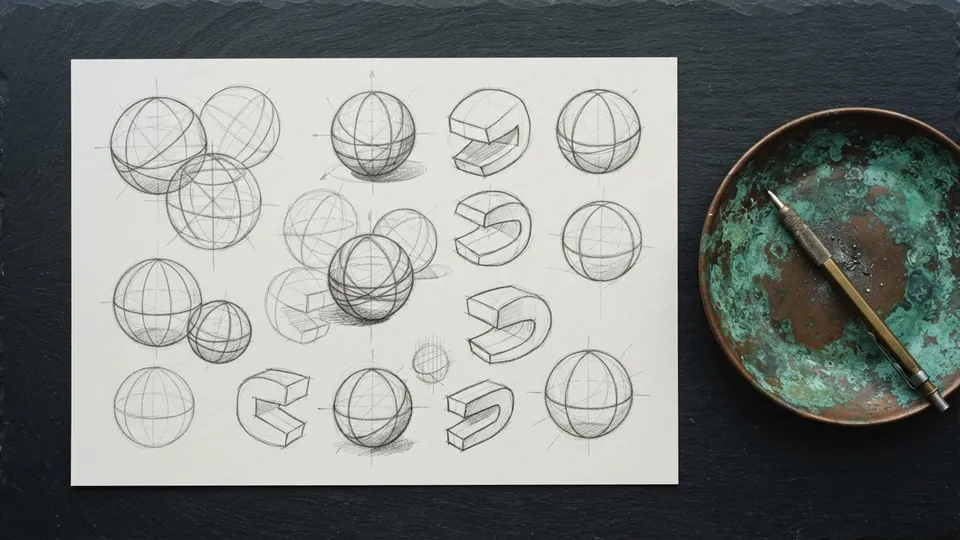
Anime face proportions start from a ball for the cranium with a jaw hung one ball radius below it. A vertical center line and a horizontal brow line wrap around the ball; the eyes sit just below the brow line at or under the head's midpoint, one eye width apart, with the nose base halfway to the chin.
Stylized heads look straightforward until you rotate them, and then the eyes slide and the jaw floats. Anime face proportions only hold when the head underneath is a solid: construct it as a ball plus a jaw, place the features on a cross that wraps around the ball, and only then style the surface. Every tutorial in the character and anime art pillar assumes this anime head construction; the measurements below are in eye heights and head widths so they transfer to any style.
The ball and jaw
Start with a sphere for the cranium. Slice a small plane off each side for the temples and ears. Then hang a jaw off the bottom: for a stylized face the jaw is a soft, tapering shape that meets at a chin roughly one ball radius below the bottom of the sphere.
The full head is about two and a half radii tall and two wide. The National Gallery describes this kind of first pass as underdrawing: construction drawn first and corrected before any finished surface goes on top. Keep it on its own layer at 30 percent opacity.
Because the ball is a 3D object in your head, not a flat circle, the cross you draw on it turns with it. That is what keeps features locked when the head turns.
The wrapping cross
Draw a vertical center line down the face and a horizontal brow line, both curving to follow the surface of the ball. In three quarter view the vertical line bows toward the far side of the face and the horizontal line arcs. If the cross is convincing the features will be too. The National Gallery's entry on perspective is the same principle at room scale: guide lines that describe a volume fix where everything on it goes.
Set the brow line
The eyes sit just below it. In stylized faces the eye line is often at or below the vertical midpoint of the whole head.
Divide for the nose and mouth
Halfway between brow and chin for the nose base, and about a third of the way from there to the chin for the mouth.
Mirror across the center line
Whatever distance one eye sits from the center line, the other matches it along the curve, not in flat space.
Hang the ear
On the side plane, between the brow line and the nose base.
Anime face proportions by view, in eye heights and head widths
One eye height (EH) is the vertical size of the open eye in your style; one head width (HW) is the widest point of the cranium. Everything scales with the eye you have already chosen, so the table works for huge shojo eyes and narrow seinen ones alike. The how to draw anime eyes tutorial covers how to pick that eye size by style.
| Measurement | Front view | Three quarter view | Profile |
|---|---|---|---|
| Eye line from top of head | 0.5 to 0.55 of head height | Same, follows the arc of the brow line | Same, marked on the side of the ball |
| Near eye width | 0.22 to 0.25 HW | 0.22 to 0.25 HW | 0.12 to 0.15 HW, drawn as a wedge |
| Far eye width | Same as near | 0.6 to 0.7 of the near eye | Hidden |
| Gap between eyes | 1 eye width | 0.6 to 0.7 eye width, measured on the curve | Not applicable |
| Nose base below brow line | 1.5 to 2 EH | 1.5 to 2 EH | 1.5 to 2 EH, tip projects 0.08 HW past the lip line |
| Mouth below nose base | 0.7 to 1 EH | 0.7 to 1 EH | 0.7 to 1 EH, set back behind the nose |
| Ear position | Brow line to nose base, at the head's edge | Near ear moves toward center; far ear hidden or a sliver | Centered on the vertical midline of the skull |
Turning the head: three quarter view and profile
For a three quarter view anime face, shift the center line off to one side and let the far eye compress. The far eye is always narrower than the near eye because you are seeing it at an angle; 60 to 70 percent of the near eye's width is the working range, and the gap between the eyes compresses by the same ratio. Tate's entry on foreshortening explains why: any form turned away from the viewer occupies less of the picture plane than its true width.
Two things beginners miss: the near cheek becomes a contour from below the near eye to the chin, and the far cheek line pushes out past the far eye. In a strong three quarter (about 60 degrees) the nose crosses the far cheek line and the far eye tucks behind the bridge.
For profile, the cross collapses to the edge of the ball and the jaw does the heavy lifting. The eye becomes a wedge with the iris at the front edge, the nose projects past the lips, and the ear sits on the vertical midline of the skull. The jaw runs from the ear down and forward to the chin in one line.
Eye line, nose base and mouth line must all curve the same way by the same amount. If one is flatter, the head is two views at once.
Age and gender shifts in anime head proportions
Every age and gender difference comes from moving a few of the numbers above. The ball stays the same; the jaw, the eye line and the eye size change.
- Child (about 6 to 10): eye line at 0.6 of head height, jaw shortened to 0.7 of a radius and rounded, eyes 0.28 HW wide, nose reduced to a dot or a short line.
- Teen (the default for most series): eye line at 0.5 to 0.55, jaw one radius, eyes 0.22 to 0.25 HW, chin softly pointed.
- Adult: eye line at 0.5 or slightly above, jaw 1.1 to 1.2 radii, eyes 0.18 to 0.2 HW with more lid crop, nose drawn with a bridge.
- Elderly: jaw slightly shorter than adult, eyes narrower still, cheek and jaw drawn as separate strokes rather than one curve.
- Male vs female in the same style: male jaw about 10 percent longer with a squarer chin, eyes about 20 percent shorter, brow line drawn heavier and closer to the eye; female chin narrower and rounder, cheek contour fuller in three quarter.
Keep the ball and cross identical and change only jaw and eye values, and a family visibly belongs together. When the head is placed, the hair as blocks tutorial shows how the hair masses sit on the same ball.
Common failures and fixes
Check the construction layer before fixing the line work; the fix is nearly always underneath.
| Symptom | Cause | Fix |
|---|---|---|
| Features will not turn with the head | Flat circle instead of a ball | Redraw the cross so both lines curve; if they are straight, the head is flat |
| Far eye looks the same size as the near eye | Eyes copied in flat space | Compress the far eye to 60 to 70 percent and the far gap by the same ratio |
| Young face looks adult | Jaw too long | Shorten the jaw to 0.7 of a radius and round the chin |
| Ear drifts around the head | Ear placed after the eyes by feel | Place the ear on the side plane between brow line and nose base before drawing eyes |
| Profile looks like a flattened front view | Eye drawn as an almond | Draw the profile eye as a wedge with the iris at the front edge; project the nose |
Anime face proportions in one pass
Ball, jaw one radius below, a wrapping cross, eyes just under the brow line at the head's midpoint, nose halfway to the chin, mouth a third below that, ear behind the cross. Those seven placements are the whole of anime face proportions, and because they live on a solid they survive three quarter view and profile without being relearned.
Common questions
What are the proportions of an anime face?
The cranium is a ball, the jaw hangs one ball radius below it, and the whole head is about two and a half radii tall. The eye line sits at or just below the head's vertical midpoint, the eyes are one eye width apart and each about a quarter of the head width, the nose base is halfway from brow to chin, and the mouth is a third of the way from nose to chin.
How do you draw an anime face in three quarter view?
Shift the vertical center line toward the far side and curve it. Compress the far eye to 60 to 70 percent of the near eye and the gap by the same ratio. Show the near cheek as a contour down to the chin, push the far cheek out past the far eye, and keep the eye, nose and mouth lines curving by the same amount.
Why does my anime head look wrong when I turn it?
Almost always because the construction was a flat circle rather than a ball, so the cross did not wrap. Redraw the center line and brow line as curves on a sphere, compress the far eye, and check that the eye line, nose base and mouth line all arc the same way.
Sources and further reading
Primary references for the facts and definitions in this piece, all from independent publishers:
- Tate: Foreshortening: how forms compress as they turn toward or away from the viewer.
- The National Gallery: Perspective: the wrapping guide lines behind three quarter and profile views.
- The National Gallery: Underdrawing: construction drawn first and corrected before the finished surface.
This method is part of the full character and anime art pillar. Pair it with How to Draw Anime Eyes: A Complete Method and How to Draw Anime Hair as Blocks, Not Strands.